


English · Español
30 de enero de 2013 | Entrevistas | Cumbre de los Pueblos Santiago de Chile | Acaparamiento de tierras | Anti-neoliberalismo | Bosques y biodiversidad | Derechos humanos | Justicia climática y energía | Luchadores sociales en riesgo | Soberanía Alimentaria
A CELAC of the Peoples
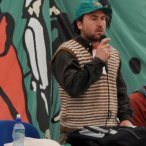
Interview with Diego Monton, of the Operational Secretariat of CLOC – Via Campesina
Descargar: MP3 (1.7 MB)
The process of development of the Community of Latin American and Caribbean States (CELAC, created by the end of 2011) was one of the fundamental issues for several Latin American social movements present at the Summit of the Peoples in Santiago de Chile, that came to an end on Sunday.
That’s why this was one of the main issues addressed at the interview with peasant leader Diego Monton, a reference for the National Peasant and Indigenous Movement (MNCI) of Argentina and the Operational Secretariat of the Latin American Coordination of Countryside Organizations (CLOC-Via Campesina).
We also spoke about the Summit of the Peoples in Santiago, the peasant concerns, the main challenges for social movements of the region, among other issues.
“One of the most important thing to highlight is the process of the summit. Obviously, this is a summit that appears to position the demands of social and popular movements against a strange move by the Chilean President (Sebastián Piñera) which was to link the discussion of CELAC to an economic discussion with the European Union”, said Monton in the interview conducted yesterday.
The leader stated that Latin American social movements have advanced significantly in achieving summits to be more than just a declaration, but also to strengthen a form of encounter, a methodology, related to plenary sessions, which also take into account national dynamics. “The organizations, when returning to their countries need to try to generate common mobilization and struggle agendas”.
“Chile was surprising, because we exceeded expectations in terms of the mobilization dynamics and the number of organizations. (…) This summit had to do with a NO to investments, transnational corporations, and therefore a NO to green economy, but also a YES to a CELAC that is useful for the peoples”, explained Monton.
The peasant leader also made reference to Piñera’s strategy, something that worries him. He considers that the right-wing president’s plan implies to ensure legal security for transnational corporations. The goal of the Chilean president was to “put CELAC at the service of transnational investments” (…) “which are causing evictions, logging, agrotoxic pollution and the looting of our natural resources”. In addition, the murders of peasant leaders in Latin America by gunmen hired by large corporations are very common. Monton regretted the murder in Brazil of leader Cicero Guedes, of the Landless Rural Workers Movement (MST) of Rio de Janeiro. Cicero was shot ten times by the gunmen.
The fact that Cuba took on the temporary presidency of CELAC in Santiago is considered by the different social movements of the region as an open door to dialogue and the conformation of this space based on to the interests of the people. Monton said that this “is an opportunity to consolidate a structure of CELAC with the goals we’ve been raising, which has to do with an articulation, a Latin American consolidation based on principles of solidarity, reciprocity and not a structure for businesses”. “And I also believe that Cuba will collaborate in structuring the participation of social movements which is almost non-existent at present. We think we have a lot to contribute to”, added the leader.
Along these lines, Monton said that “we have in mind a CELA that strengthens the sovereignty of the peoples, national sovereignty based on a continental project that truly allows Latin America to take the leap history is demanding, towards a development model based on the interests and potential of the peoples. -
The interview then addressed the peasant issue. CLOC is raising new development strategies. “They are not making reference to the inability to export food, for instance, but to export food we need first to ensure food sovereignty, sovereign agriculture, peasant, indigenous and then replace transnational companies as en element of commercial exchange”, said Monton. “We think that CELAC is a great opportunity to think about the mechanisms of “grannational” companies, based on a popular logic, which can ensure this exchange of Latin America with other continents”.
When speaking about the alternatives proposed by the peasant movement, food sovereignty, the political proposal by Via Campesina is without a question extremely important due to its value for the people who live in the countryside, and as an important part of the solutions against global climate change. The advance of the integral agrarian reform, suspended in almost the entire region, is also fundamental, according to Monton. “The only way to strengthen food sovereignty is peasant indigenous agriculture. First of all, we need to stop the advance of transnational corporations over lands and natural resources, and we should also advance over land in terms of food sovereignty", said the leader. “And that’s why we insist on the integral agrarian reform, which is not only land for those who work (…). It needs to focus in the return to the countryside of millions of families, which are today experiencing precarious situations, and many times subjected to slave work in the outskirts of the cities”, he added. Then he highlighted other urgent needs, such as the building of local markets, access to health, education and communication services in peasant communities, which should be adapted to the culture of each place.
Photo: ciudadtombola.blogspot.com