

English · Español
22 de octubre de 2012 | Entrevistas | I Asamblea Continental CLOC - Vía Campesina | Bosques y biodiversidad | Soberanía Alimentaria
A Concept That Does Not Get Old
Food Sovereignty: Interview with María del Carmen Barroso (Association of Small-Scale Farmers of Cuba)
Descargar: MP3 (1.1 MB)
Twenty years after the creation of the Latin American Coordination of Countryside Organizations (CLOC-Via Campesina), the situation in the continent has changed radically since the 90s, a time dominated by neoliberal governments. Nowadays those neoliberal regimes were defeated in almost every country.
The assessment of peasant organizations of the past two decades since the creation of CLOC takes these changes into account, while it points out the new challenges for social movements to achieve structural changes for peasant agriculture.
Real World Radio interviewed Carmen Barroso, member of the National Association of Small-Scale Farmers of Cuba (ANAP). She said that in countries where revolutionary changes have been achieved, the peasant issues and all issues related with food sovereignty have a special focus.
“CLOC is playing a fundamental role in Latin America”, she said. Especially in terms of solidarity and of raising awareness about the criminalization of the peasant struggle in the continent.
María del Carmen wants to see CLOC “mobilized and reorganized to answer to these problems and to put pressure on governments so that they comply with the demands of the communities and popular social sectors”.
However, despite there being many governments that do not respond to the capitalist policies in the continent, the pressure of the oligarchies of some countries have led to situations that were thought to be over in the continent, like the coups d’état in Honduras and Paraguay.
Even under progressive governments “we need to insist and explain what food sovereignty means”, she said, while exposing the risks posed by large infrastructure projects, mining exploitation or genetically modified organisms.
Maria del Carmen highlighted the need for greater and better planning to tackle climate change and the role played by the farmers in Cuba. There is a need to have innovative practices and knowledge to reduce the dependence on food imports.
A new distribution of land took place in 2008, when 1.2 million hectares of land were allocated to young people, to peasants’ children. The increase in the global food prices and the climate crisis led to the Cuban State to promote university courses linked with agronomy.
The Cuban leader talked about the challenge of self-supply, production and commercialization in her country.
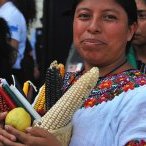
Photo: Cloc- Via Campesina Continental