



19 de noviembre de 2012 | Noticias | Agua | Gira Internacional de Solidaridad con comunidades afectadas por megaproyectos mineros en Centroamérica | Industrias extractivas | Luchadores sociales en riesgo
Months of Resistance
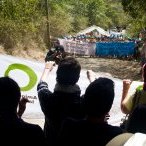
Protesters Block Entrance to Canadian Mining in Guatemala City
Descargar: MP3 (1.5 MB)
San José del Golfo and San Pedro de Ayampuc are two towns near Guatemala City that have been affected by gold and silver mining. Mining activities began in the area in 2000 but the community only found out in 2010.
Radius Gold Corporation is operating in the area as a counterpart for Explotaciones Mineras de Guatemala (Exmingua). Servicios Mineros de Centroamérica is a subsidiary that exerts pressure among the population and does the so called social corporate responsibility work.
Antonio Reyes, leader in defense of the territory, says “they are just taking advantage of people’s misery and of people’s knowledge to persuade them and gain their support”.
The license for the exploitation of the mine is for 25 years in a 20km2 area, where they plan to have 14 mining projects. This area includes the municipality of San José del Golfo and the largest village, Cholena. It also includes communities of the neighboring municipality San Pedro de Ayampuc. Mining exploitation threatens 5,000 families that depend on agriculture for their livelihood and who would be automatically left out of work, without resources to produce food and no possibility of satisfying their basic needs.
“The mining corporation offers economic development to the families and communities and has the nerve to hand out flyers saying that they bring economic development and that they will create 70 jobs over 5 or 7 years. Then they leave and leave people unemployed while 5,000 families who live on agriculture are left out of work for life”, Reyes told Real World Radio.
There is plenty of water in the area where the exploitation Project is located. This situation alerts the organized communities against mining, because they find the project incompatible with water availability and the fertile soil. Also, the infrastructure projects, such as paving the road, will not be beneficial for the communities, they would just serve the exploitation and benefit of the transnational corporation, while water runs out.
“On March 2, 2012 several people of the community began the resistance. A woman saw one of the bulldozers coming and she was so outraged to see how they were entering our territories without prior consultation, how they were moving lands and logging the forest, that she told the vehicle she could not go through. So people started to join her”, said Reyes. The community leader said people’s outrage has contributed to join several social groups around a common objective: defending life, regardless of their political affiliation, religion, ethnic group or social sector, they all want to live and they are defending water preservation.
As months go by and the organized community continues to block the entrance to the mine, the situation is becoming more tense, since the company is paying groups of people from the region to confront the demonstrators, a strategy to divide the community.
However, Reyes said that they will continue fighting and demonstrating peacefully. We are convinced that this is the only way for the government and the mining corporations to stop doing whatever they want and we are convinced that we are legally entitled to do this. We don’t mind dying, we hope it will not happen but if we die it does not matter because that would strengthen the resistance”.