




English · Español
27 de agosto de 2012 | Noticias | Agua | Acaparamiento de tierras | Anti-neoliberalismo | Derechos humanos | Justicia climática y energía | Luchadores sociales en riesgo
Resistance to El Quimbo Dam in Colombia
Colombian Office Starts Probe into El Quimbo Dam
Descargar: MP3 (2.5 MB)
Descargar: MP3 (1.9 MB)
The Association of People Affected by El Quimbo Dam (ASOQUIMBO) in Huila department, Colombia, will demand the State Council to immediately stop the project. The move is a result of a resolution issued on Wednesday by the country’s General Comptroller’s Office of opening a preliminary investigation into the project, after finding purported irregularities in the granting of an environmental license.
According to the office, which based its findings on studies by ASOQUIMBO and on their own studies, the irregularities may have caused around 195 million dollars of social, environmental and economic damage.
ASOQUIMBO will demand “as a precautionary measure to avoid this disaster, this damage to our heritage, to stop El Quimbo dam immediately, while there is an investigation into the responsible and a compensation is paid for the damages”, Miller
Dussan, professor of the Universidad Surcolombiana and member of ASOQUIMBO told Real World Radio. He is in Bogota preparing the legal action to be filed.
The association of people affected by El Quimbo will also demand the payment of a compensation to all the communities affected by the building of the project. They have also called a big meeting on September 20 in Huila department so that the local communities and the people affected will gather to push for the suspension of the project.
El Quimbo is a project owned by Emgesa, a branch of Spanish corporation Endesa and Italian corporation Enel. It is being built on river Magdalena and it will affect several municipalities in Huila. It is estimated that it will flood 7,300 hectares of land and nearly 800 families will be displaced from their lands.
Workers who have been displaced as a result of Emgesa’s purchase of their lands have begun to return to their lands to harvest since they consider they were illegally expropriated.
Dussan highlighted that the conclusions of the country’s Comptroller’s office agree with the outcomes of ASOQUIMBO’s studies. The people affected by El Quimbo had shown that the process to grant an environmental license had been illegal and there were serious repercussions on the national and regional heritage of around 195 million dollars. According to Dussan, this figure is higher than the investment made by Emgesa for social and environmental compensation. The Comptroller’s office decided to begin a procedure of fiscal responsibility against the Ministry of
Environment and the National Authority of Environmental Licenses.
Dussan mentioned the economic, social and environmental damage caused. “They acknowledge the destruction of the production chain, the damage ot the region’s food security, the displacement caused by the purchase and selling of land of Endesa, the destruction of community business in the region and the pscycho-social damage. There has been destruction of strategic ecosystems as well”.
Dussan believes that the main conclusions of the Comptroller’s Office is that “the Ministry of Environment is responsible because it acted to benefit the transnational corporation and it changed the environmental license ten times to make it adapt to its demands”. This is why we “have always said that the Ministry of Environment has acted as a branch of transnational corporations”, he said. He also mentioned that the former administration of Alvaro Uribe granted permission to build El Quimbo “above the laws and the Constitution”.
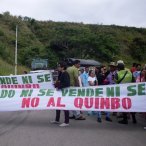
The activist welcomed the local resistance against El Quimbo, which has the support of the Movement Ríos Vivos of Colombia and the Movement for the Liberation and Defense of Mother Earth in Huila. This resistance and struggle has had to face repression by public forces and Riot Police against a peaceful demonstration held on August 13. On that day, 2,000 fishermen, peasants and indigenous blocked the road that leads to Hobo municipality to express their rejection to mining and energy mega projects and to demand a political solution to the national armed conflict. Thousands of demonstrators and police officers were injured.