

25 de febrero de 2013 | Entrevistas | Agua | Industrias extractivas | Luchadores sociales en riesgo
The Limits to Mining
Interview with Pablo Sanchez (Grufides): Ollanta Humala’s Mining Push and the Lead-up to a Popular Consultation on Conga Project
The indiscriminate push for the extraction of raw materials, especially minerals, and its effects on communities is a central issue of the social conflicts in Peru under Ollanta Humala’s administration, Pablo Sanchez, leader an environmental organization of Cajamarca Grufides, told Real World Radio.
The Conga project in Cajamarca has placed the importance of water for life and the communities’ relation with mining at the center of the national and international debate, said Pablo Sanchez*.
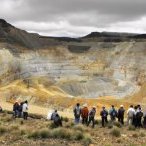
The Conga project, led by Yanacocha mining corporation, was the focus of the social mobilization last year in Peru. The communities and supporting organizations face the challenge of carrying out a popular consultation in 2013 to stop the advance of the project which, because of its large scale, would worsen the already visible impacts of mining two decades after this activity was first developed in the region.
Pablo Sánchez says that all the communities associated with the basins of Cajamarca would be affected. In spite of this, the environmental impact study carried out by Yanacocha only considers 3% of the population. “The study is superficial, it underestimates the impacts”, he says.
Some of the key elements of the project includes the construction of a big mine tailing, apparently the biggest in Latin America, that will use highly toxic substances and heavy metals affecting at last three basins.
Sanchez said the populations consider the government and even the police and the army as explicit allies of mining corporations. The communities have exposed this before national and international human rights agencies, they have engaged in awareness raising campaigns. All this has led the majority of the population (peasants, indigenous and urban dwellers) to oppose the project. The aim of the organizations is to reflect this rejection in a popular consultation. However, the Peruvian law provides that popular consultation can only be made among native peoples and they claim that in the region affected by Yanacocha there are no indigenous settlements.
Sanchez replied that this is a citizen right “not related with the origin of the community, but to the consent of communities after being aware of the effect the project would have on their lives”.
Several Examples
Even though community consultations done in other countries are a good example for Peru, the scale and scope of this one is a challenge for the people affected and the supporting communities.
Besides the rejection to the project, this could also imply creating a debate around the development model, says Pablo Sanchez.
Polls are an indication: last year a poll found that 70% of the people of Cajamarca opposed the project. “What better way to express the popular will on their territories, their future than by a popular consultation?”, wonders Pablo.
Yanacocha said the consultation is illegitimate and that it damages business interests: “A popular consultation would be a bad precedent not only for Conga but for the whole industry in Peru”, said the leader of the consortium Javier Velarde cited by RPP news site.
Finally the environmentalist sends a message of solidarity with similar movements that defend life and fight against extractive industries in Latin America. “This is a struggle of joy, although there is a lot of sadness on the way. It is a struggle for life”, he said.
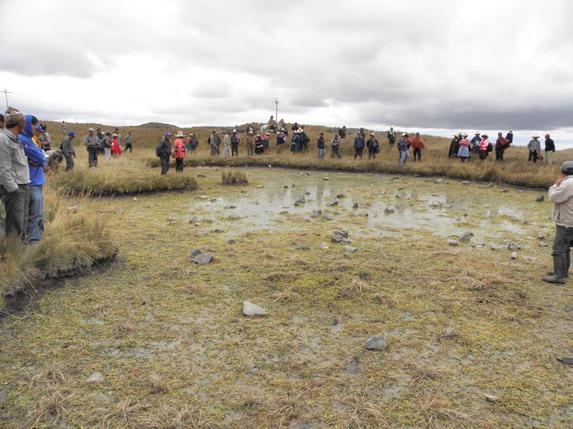
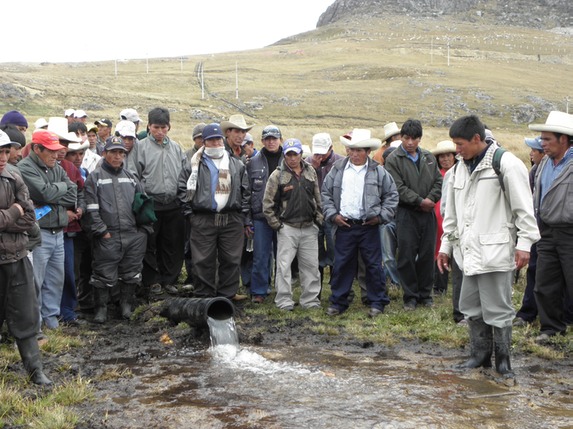
The photo gallery shows one of the cast implied by Yanacocha project and its impacts. The company has been trying to mitigate the effect of the drying out of wells by pumping water treated in their sinks to higher areas. But the process implies using a lot of energy and does not guarantee water quality. “Who is going to pay for the pumping and treatment of water when the company is no longer operating? No government authority is supervising this procedure. So water management is left entirely to the company”, says Grufides’ website.
Photo gallery: http://www.grufides.org
* Interview done by Grace Garcia, member COECOCEIBA-Friends of the Earth Costa Rica, during a recent tour in Peru.
Portafolio